


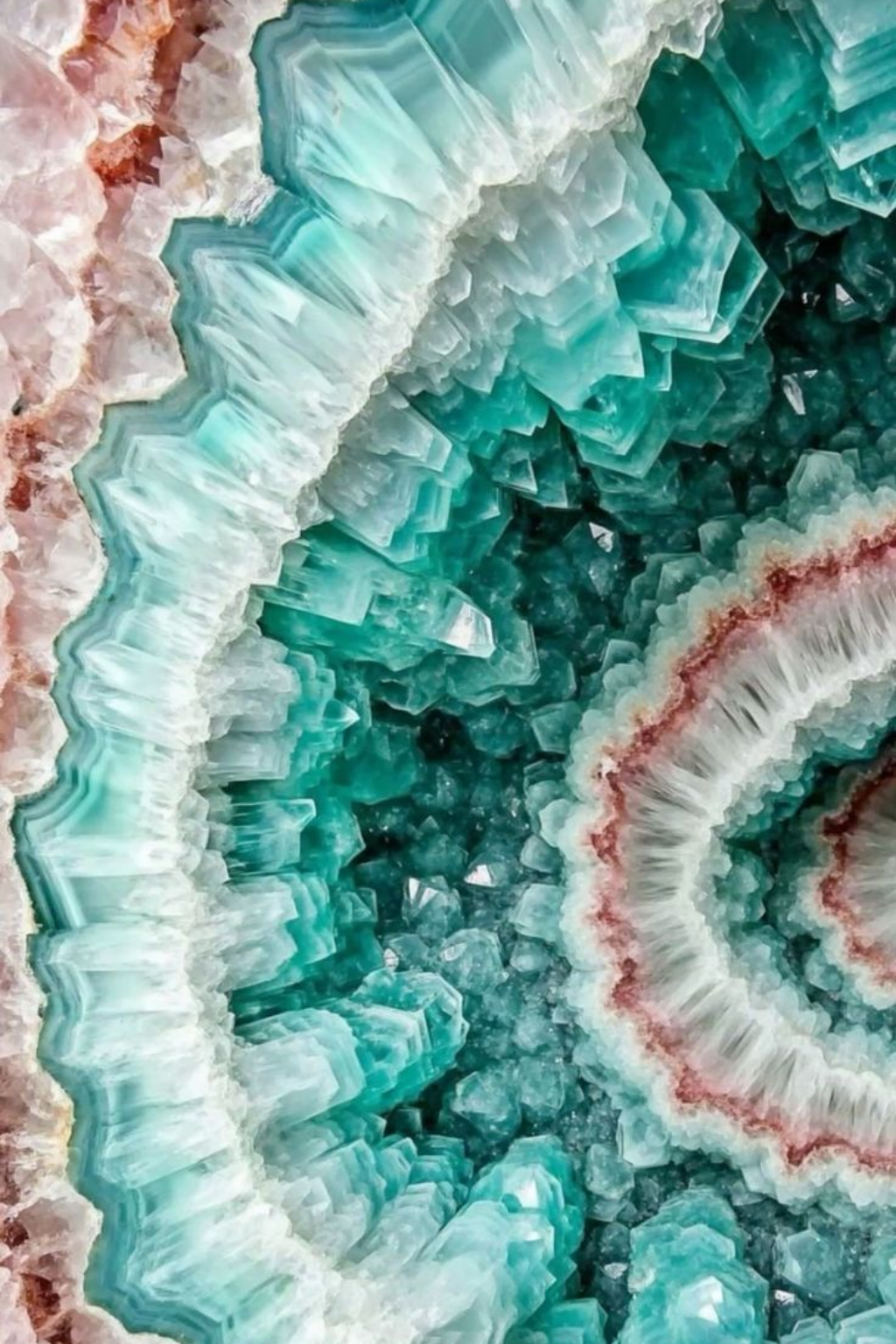
Miniature Universes
The Hidden Worlds Inside Gemstones
At first glance, a gemstone is small. Contained. Finite.
But look closer — really look — and it begins to shift.
A piece of labradorite flashes like distant light through water.
Jasper reads like an aerial map of somewhere ancient.
Quartz holds fractures that resemble frozen lightning.
Each stone is not just an object.
It is a record.
Of heat.
Of pressure.
Of movement beneath the earth over millions — sometimes billions — of years.
In that sense, every gemstone is a miniature universe. A moment of the earth’s history, captured and held in form.
Let’s step inside.
Quartz: Frozen Time & Light
Quartz is one of the most abundant minerals on Earth — yet no two pieces feel the same.
It forms when silica-rich water slowly cools and crystallises, often inside cavities within rock. As the liquid cools, atoms arrange themselves into a repeating structure — growing, layer by layer, over time.
What makes it fascinating:
- Those internal “flaws”? They are interruptions — shifts in temperature, pressure, or mineral content mid-growth.
- Crackle quartz is intentionally heated and cooled to mimic natural fractures — echoing the way real quartz responds to sudden change.
- Rutilated quartz contains fine threads of titanium dioxide — literally minerals growing inside minerals.
Quartz doesn’t just form — it records events.
Jasper & Agate: Landscapes in Stone
Jaspers and agates form from silica-rich solutions filling voids in rock, often volcanic in origin. Over time, minerals deposit in layers, creating bands, swirls and patterns.
What you’re actually seeing:
- Each band = a different moment in time
- Each colour = a different mineral present during formation
- Each pattern = the path of mineral-rich water as it moved
Picture jasper often looks like deserts or mountains because… it essentially is a geological snapshot.
These stones are not designed. They are accumulated.
Labradorite & Feldspar: Light Beneath the Surface
Labradorite belongs to the feldspar family and forms in molten rock that cools slowly beneath the earth’s surface.
Its signature flash — known as labradorescence — is caused by light refracting between microscopic layers within the stone.
What feels almost unreal:
- The colour isn’t on the surface — it’s inside
- As the angle shifts, different wavelengths of light are revealed
- You’re not seeing pigment — you’re seeing physics
It’s essentially a stone that holds light… and releases it selectively.
Malachite & Azurite: Growth Through Reaction
Malachite and azurite form through chemical reactions between copper minerals and water near the earth’s surface.
They grow in concentric layers, almost like rings in a tree.
What makes them remarkable:
- Their vivid colour comes directly from copper
- Their patterns form as minerals deposit outward in waves
- They are constantly responding to their environment during formation
Malachite, in particular, looks alive — almost botanical.
It’s a stone that feels like it grew rather than crystallised.
Garnet: Pressure & Precision
Garnets form deep within the earth under intense heat and pressure, often within metamorphic rock.
They grow into perfect geometric shapes, most commonly dodecahedrons (12-sided crystals).
What’s fascinating:
- Their symmetry is not carved — it’s natural
- They can form over hundreds of millions of years
- They are incredibly durable, surviving geological upheaval
Garnets are a reminder that structure can emerge from pressure.
Turquoise: Water’s Imprint
Turquoise forms in dry, arid regions when water seeps through copper-rich rocks.
As the water evaporates, it leaves behind mineral deposits — slowly building turquoise within cracks and veins.
What you’re seeing:
- The “matrix” (veins) = host rock that remains
- The blue/green = copper and aluminium minerals
- Each piece = a map of water movement through stone
It is, quite literally, a trace of water in solid form.
Obsidian: Instant Transformation
Obsidian is not technically a crystal — it is volcanic glass.
It forms when lava cools so rapidly that atoms don’t have time to arrange into a crystalline structure.
What makes it unique:
- It forms almost instantly (geologically speaking)
- Its smooth surface is due to the lack of crystal structure
- Snowflake obsidian forms when crystals begin to develop within the glass
It is the opposite of slow formation — a moment of heat, frozen.
Petrified Wood & Fossil Stone: Time Preserved
These are not just stones — they are transformed remains of living material.
Petrified wood forms when organic material is gradually replaced by minerals, preserving its structure in stone.
Fossil stones form when ancient organisms leave behind imprints or mineralised remains.
What’s extraordinary:
- You are seeing something that once lived
- The structure is preserved, but the material has changed
- It is both past and present in one form
These stones hold memory in the most literal sense.
Why This Matters When You Wear Them
When you wear a gemstone, you are not just wearing colour.
You are wearing:
- compressed time
- geological movement
- chemical transformation
- moments of stillness and intensity
Each bead has travelled through processes we cannot replicate — only witness.
That quiet awareness changes how jewellery feels.
It becomes less about decoration…
and more about connection.
A Closing Thought
Every gemstone has endured something to become what it is.
Pressure. Heat. Movement. Change.
And yet — what we see on the surface is beauty.
Perhaps that is why we are drawn to them.
Not just because they are beautiful…
but because they remind us that transformation is.
Discover the Collection
Explore pieces formed by time, shaped by nature and chosen with intention.
Wear something that holds a story far older than your own —
and make it part of yours.


Post a comment